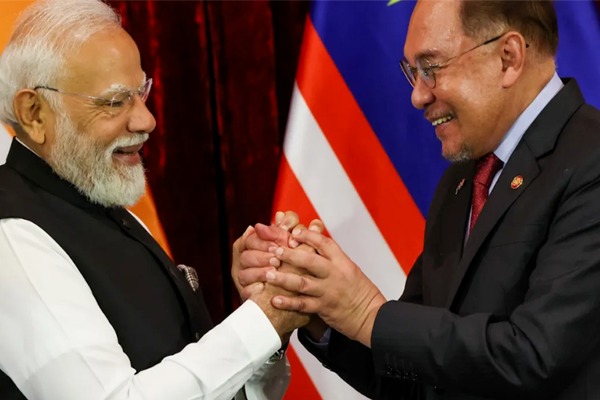

Modi praises India’s second biggest Diaspora in Malaysia, signs 11 bilateral deals
Indian Prime Minister of India Narendra Modi’s official 2-day visit to Malaysia resulted in 11 key agreements to strengthen bilateral cooperation, and he credited the second biggest Indian diaspora of nearly 5 million in Malaysia for stable and expanding ties. Indo-Malaysia agreements cover trade & investment, semiconductor & technology cooperation, security & disaster management, healthcare & social security, TVETs for labor & skills development, maritime, seafarer training & UN peacekeeping, media, culture & wildlife conservation. Indian Diaspora leaders have hailed the visit, which was applauded several times during Modi’s visit by Malaysian Prime Minister Anwar Ibrahim. Dr. Log Gopala Krishnan, Group Chairman/CEO of the Atlantic Group of Companies Malaysia (ACL) and President of the Logistics and Container Owners Association (LOGCO), said the visit marks a major step forward in enhancing bilateral strategic partnership and long-term economic collaboration. Mr. V. K. Regu, President of the People of Indian Origin Chamber of Commerce and Industry (PIOCCI) and President of the India Contractors and Builders Association of Malaysia, said Modi’s visit raised the bar on bilateral strategic cooperation. The agreements broadly push up cooperation and trade as follows: 1. Will boost in bilateral trade volume due to stronger government-to-government cooperation. Growth is expected in manufacturing cargo, electronics & semiconductor components, FMCG, pharmaceuticals, and raw materials through maritime trade. 2. Semiconductor & Technology Cooperation will increase due to high-value cargo movement and sensitive & time-critical shipments. Malaysia’s ports and logistics providers will play a key role in regional supply chains. 3. Maritime & Seafarer Agreements will push cooperation in seafarer training and certification that will support shipping, crewing, and maritime services and boost Malaysia–India maritime connectivity. 4. Digital Payments & Trade Facilitation will see a huge rise due to the introduction of India’s UPI system in Malaysia. This will facilitate easier payments for SMEs and cross-border traders and push towards local-currency trade settlement due to faster transactions, lower costs, and smoother trade operations. 5. Labor & TVET Cooperation for Skilled Workforce Development will result in better-trained logistics, port, warehouse & transport personnel and support long-term sustainability of the logistics sector.