
India Assembly Elections 2026 Results: Landmark Shift in Voters’ Choice Across 5 States
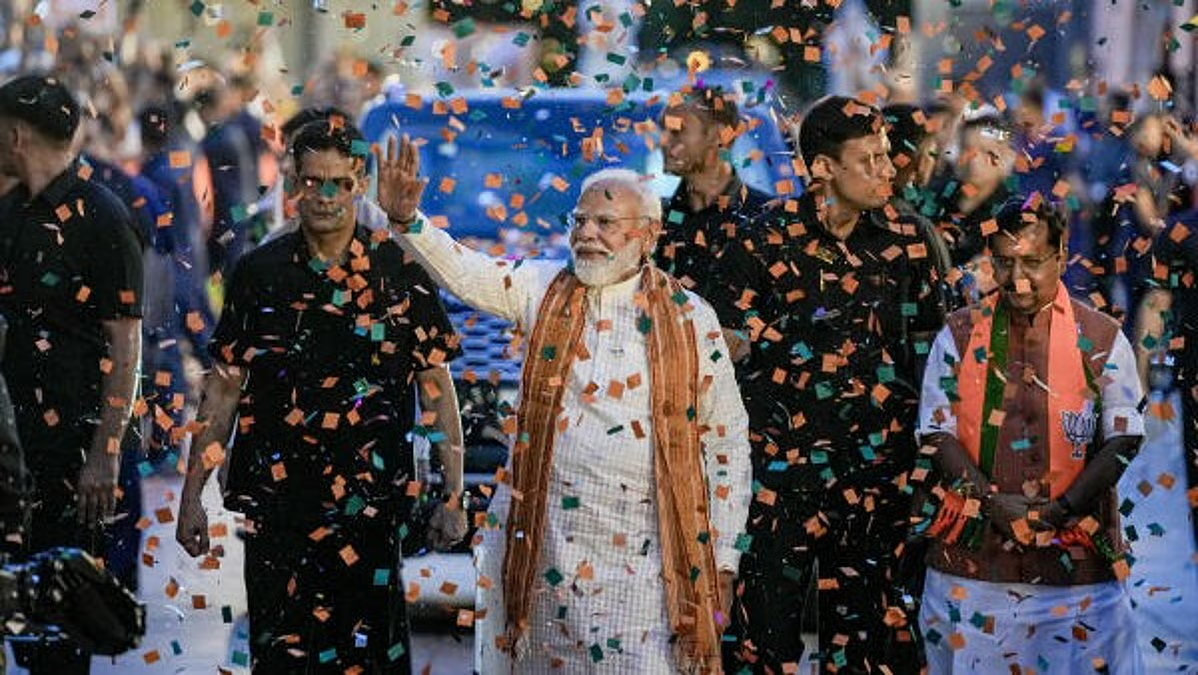
Election results in five states of India in 2026 have demonstrated a landmark shift in people's choices. Two years after Prime Minister Narendra Modi’s Bharatiya Janata Party (BJP) and its National Democratic Alliance (NDA) formed the Modi 3.0 government in June 2024, the 2026 state assembly results are dramatic. Analysts say the common thread is a change that voters would like to see. The BJP wrested control of West Bengal from outgoing Chief Minister Mamta Banerjee and, for the first time in 75 years, from communists and socialists. West Bengal will be given a huge infrastructure development thrust by the BJP government and is bound to see the return of industry in a big way. After all, Kolkata (erstwhile Calcutta and the entry point of the East India Company that later led to the British Raj in India for 200 years) is a major gateway to Southeast Asia and a trading port for the east and northeast of India. Assam, as the largest and first of 7 states of slowly developing northeast India, returns strongly to the BJP for the third time. It is bound to benefit the entire northeast with development funding from the center. BJP-supported NDA ally AINRC returns to power in Puducherry, a union territory strategically adjoining Tamil Nadu in southern India. C. Joseph Vijay, a heartthrob of Tamil people with 8 blockbuster films, makes a dynamite entry to oust two major parties to now form the government. The Indian National Congress takes the state of Kerala back from Communists after a 10-year reign; this marks a formal end to any state of India run by Communists. These certainly are impressions of a wave of change sweeping India. Analysts do believe that millennials, Gen Z, women, and Hindu voters have a lot to do with it. Hindu and pro-BJP voters played a significant role, at least in West Bengal, voting in large numbers, perhaps also without fear, unlike in the past when they felt threatened by Mamta’s All India Trinamool Congress (AITC) to stay away from elections. Assam and the northeast are aligning with the BJP to benefit from the central government’s largesse in schemes that spend billions of dollars for development in the region that remained fraught with separatist-terrorist violence. While Tamil Nadu over the last three decades witnessed a lot of investment and manufacturing domestically and by foreign companies, progressive growth was missing. Tamilians, especially outside a few major cities, lacked everything in progressive development. After these elections, the BJP directly rules 17 states and union territories of India and another two with its NDA partners. The BJP also administers 5 union territories through federally appointed lieutenant governors. That makes a third of India, 22 out of the total of 33 states and union territories, run by the BJP and NDA. The BJP's slogan of delivering socio-economic impact development through a ‘double-engine’ government, i.e., federalism, focuses on women voters and massive infrastructure development that provides much-needed employment to the bottom-of-the-pyramid population and keeps the economy injected towards growth in an otherwise major global slowdown, seeming to deliver for the voters. India’s rising global stature as a geostrategic player and a place between the 4th and 6th biggest world economies, a slew of Free Trade Agreements (FTAs) across the world with major economies, cleverly crafted mobility arrangements with the countries to allow people to grab jobs overseas, and growing diplomatic and economic ties that spur Indian investments overseas are all liked by the people who voted for the change. Here is the final standing from the Election Commission of India for the 5 state assembly elections announced on 5th May 2026.